

 Get Estimate
Date: 18‑Apr‑2025
Understanding the Hidden Threat Beneath Solid Structures
Concrete is often marketed as a pest‑proof material, giving homeowners a false sense of security. Yet seasoned pest‑control professionals know that Subterranean and Dampwood termites can—and frequently do—nest behind or beneath concrete barriers. These insects do not consume concrete; instead, they exploit its microscopic imperfections to reach the cellulose they crave. Because the invasion takes place out of sight, severe damage can occur long before the first visible warning sign appears.
In this in‑depth guide we will explore how termites infiltrate concrete, how they maintain life‑supporting conditions inside walls and slabs, the red flags every homeowner should watch for, and the most effective treatment and prevention strategies available in 2025.
Can Termites Really Live in Concrete?
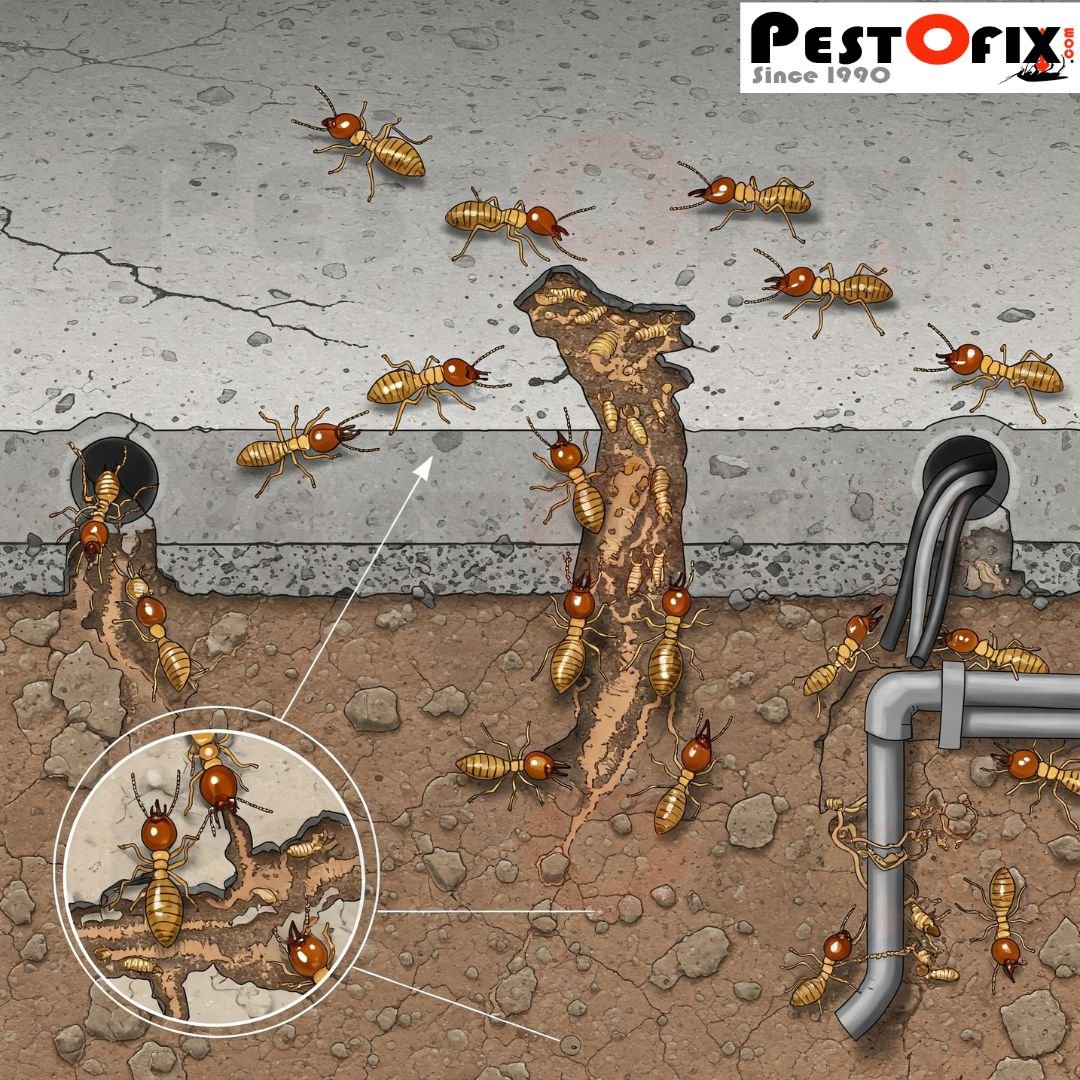
Termites lack the jaw strength and chemistry to digest mineral‑based materials. They survive in concrete environments by traveling through existing hairline cracks (as thin as 0.5 mm), construction joints, and utility penetrations. Once they reach wood, insulation, or even cardboard boxes stored against a wall, they establish a feeding site while using the concrete as a protective shell.
Why Concrete Isn’t a Perfect Barrier
- Shrinkage & Settlement Cracks – Micro‑fractures form as slabs cure and buildings settle.
- Cold Joints – When a pour is interrupted, a vertical seam remains vulnerable.
- Formwork Tie Holes – Unsealed tie‑rod gaps are express lanes for insects.
- Service Penetrations – Plumbing, electrical, and HVAC pipes often leave annular spaces.
- Expansion Joints – Flexible fillers deteriorate over time, leaving gaps.
How Termites Enter Concrete Structures
The primary invaders are Subterranean termites (Coptotermes and Reticulitermes genera). They originate in soil and construct mud tubes—pencil‑thin tunnels made of soil, saliva, and feces—to bridge hard surfaces and preserve humidity. These tubes can extend dozens of feet upward along foundations until they locate wood framing, flooring, or drywall paper.
- Follow foundation footings upward through slab cracks.
- Crawl through foam insulation boards outside the stem wall.
- Use weakened expansion‑joint filler as pre‑built passageways.
- Enter via brick veneer cavity walls where mortar joints fail.
Environmental Conditions Termites Need—and How They Create Them
Termites require a stable temperature (25–35 °C) and near‑saturated humidity (85–99 %). Inside concrete they accomplish this by:
- Sealing cracks with mud plaster to trap moisture.
- Circulating water from the soil through capillary action inside their tubes.
- Positioning nests near bathroom drains and leaky plumbing that raise ambient humidity.
- Harvesting metabolic water produced during cellulose digestion.
Warning Signs of Termites in Concrete Walls
- Earth‑colored mud tubes on exposed slab edges or piers.
- Fine cracks widening faster than normal settling would explain.
- Paint that bubbles or peels because of hidden moisture.
- Hollow or papery sound when you tap skirting boards or door frames.
- Discarded wings from swarming alates near windowsills.
Inspection Techniques Pros Use
- Infrared thermography – Detects heat anomalies from moist termite galleries.
- Moisture meters – Identify high‑humidity pockets behind walls.
- Borescope cameras – Visual confirmation inside voids without major demolition.
- Acoustic emission devices – Pick up feeding noises within wooden studs.
Treatment Options When Termites Invade Concrete
Chemical Soil Barriers
Liquid termiticides such as fipronil or imidacloprid are injected around the footing to create a lethal zone that foraging workers cannot cross. A professional must trench or drill through patios to achieve a continuous seal.
Baiting Systems
Low‑toxicity cellulose stakes infused with hexaflumuron or noviflumuron are installed in the soil every 10–15 ft. Workers bring the slow‑acting toxin back to the colony, eliminating the queen within three to six months.
Prevention: Before and After Construction
- Pre‑construction soil treatment – Apply termiticide at 5 L/m² before pouring slabs.
- Physical barriers – Stainless‑steel mesh or basaltic granules at cold joints.
- Reticulation piping – Built‑in conduits allow easy re‑application of chemicals every five years.
- Proper grading – Maintain an 8‑inch clearance between soil and siding.
- Regular gutter maintenance – Prevents water accumulation near the foundation.
Frequently Asked Questions
Do concrete additives make slabs termite‑proof?
Admixtures containing insecticidal compounds can deter tunneling for a limited time, but cracks formed later will still allow passage. They are best used in combination with soil barriers.
How long after treatment can termites return?
Modern non‑repellent termiticides remain active in soil for 8–10 years. Annual inspections ensure any breaches are caught early.
Will metal framing stop termites?
Steel studs cannot be consumed, but termites may construct shelter tubes over metal to reach drywall paper or roof trusses. Comprehensive protection is still necessary.
Conclusion
Concrete slows termites but never stops them. Understanding their infiltration tactics and survival mechanisms empowers you to act before extensive damage occurs. If you suspect activity, contact a licensed pest‑control expert for a thorough inspection and tailored treatment plan. Vigilance today preserves the integrity—and value—of your property tomorrow.