
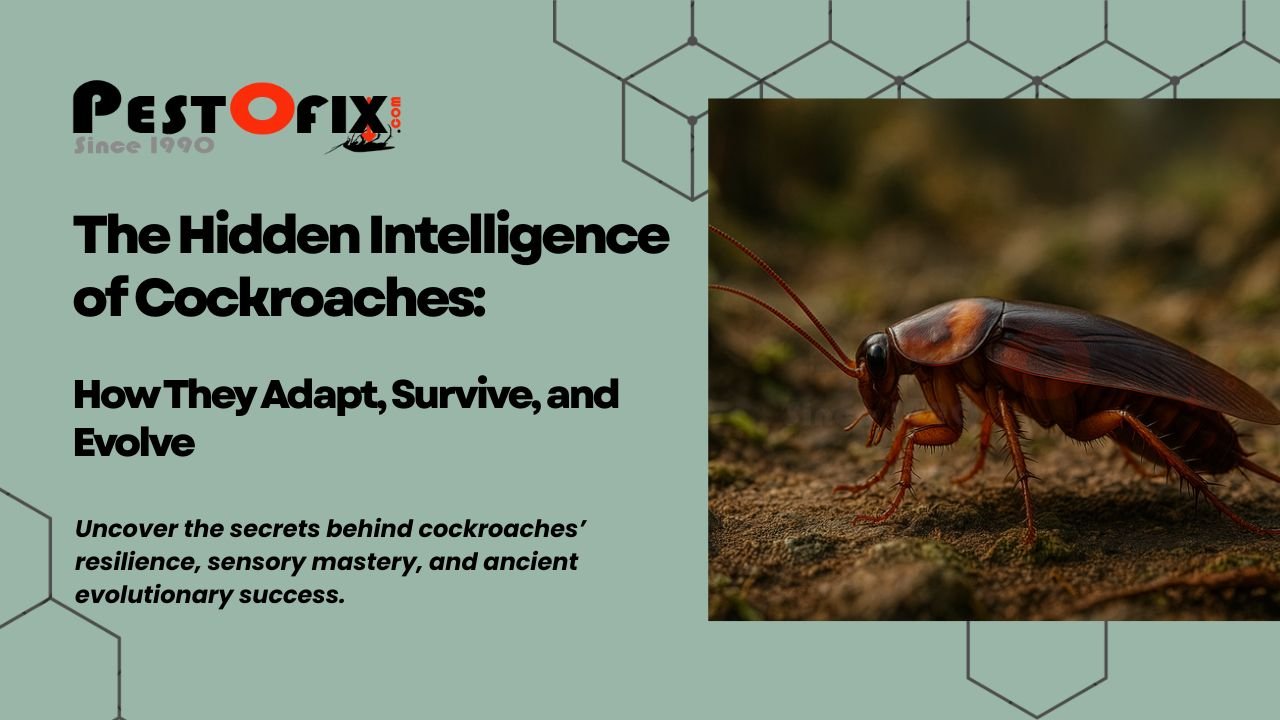
The Hidden Intelligence of Cockroaches: How They Adapt, Survive, and Evolve
Introduction
For centuries, cockroaches have been symbols of disgust and survival. Yet beneath that reputation lies a creature of astonishing adaptability and biological intelligence. They have existed on Earth for over 300 million years — long before humans, dinosaurs, and even flowering plants. Their ability to evolve, sense danger, and adapt to virtually every environment makes them one of nature’s most efficient survivors.
This guide explores the hidden intelligence of cockroaches — how they think, move, adapt, and evolve. You will discover how their biology and behavior make them nearly indestructible, and why scientists study them to understand resilience, neural processing, and even robotics.
The Evolutionary History of Cockroaches
Cockroaches belong to the order Blattodea, a lineage that dates back over 300 million years. Fossil evidence shows that ancient roaches coexisted with early amphibians and giant ferns in the Carboniferous period. Their basic body design has changed very little since then — proof of evolutionary perfection.
Unlike many species that evolved rapidly and disappeared, cockroaches found stability in simplicity. Their flat, flexible bodies, durable exoskeletons, and fast reproductive cycles ensured survival through mass extinctions, ice ages, and dramatic climate shifts.
- Fossil Resemblance: Modern cockroaches are nearly identical to fossils found 250 million years ago.
- Early Diet: Ancient roaches fed on decaying vegetation — a role they still perform today in ecosystems.
- Shared Ancestry: Modern termites evolved from ancient cockroaches, sharing social traits and gut bacteria.
Anatomy Built for Survival
The cockroach body is a masterpiece of biological engineering — built not for beauty, but for survival. Each part serves a purpose that enhances mobility, awareness, and resilience.
- Flattened Body: Enables them to slip through gaps as thin as 3 millimeters, making escape almost effortless.
- Exoskeleton: A flexible yet tough armor made of chitin that resists crushing and chemical exposure.
- Leg Design: Six legs with spines for grip allow cockroaches to run up to 80 centimeters per second — one of the fastest speeds among insects relative to size.
- Regenerative Ability: They can regrow lost limbs during molting cycles, maintaining functionality even after injury.
This physical perfection is complemented by a highly sensitive nervous system — one that reacts faster than human reflexes.
The Cockroach Nervous System: A Decentralized Brain
Unlike humans, cockroaches do not rely on a single central brain. Their intelligence is distributed throughout their body, with clusters of nerve cells called ganglia controlling specific functions. Even after decapitation, their bodies can survive for days because most vital processes — movement, digestion, and reflexes — operate independently.
- Cephalic Ganglion (Head): Handles sensory processing and decision-making.
- Thoracic Ganglia: Control leg movements and coordination.
- Abdominal Ganglia: Regulate breathing and reflex reactions to danger.
This distributed intelligence makes them incredibly hard to kill. Even without a head, their bodies can continue walking, responding to touch and light, powered by internal nerve circuits.
The Sensory World of Cockroaches
Cockroaches live in a sensory universe invisible to humans. They use highly evolved organs to detect movement, vibration, and changes in air pressure — allowing them to escape predators or humans within milliseconds.
- Cerci: Small hair-like sensors on the rear detect the slightest air disturbance — triggering instant escape.
- Antennae: Packed with over 10,000 sensory neurons for detecting odor, temperature, and humidity.
- Compound Eyes: Each eye contains thousands of light-sensitive units (ommatidia) that help detect motion, even in near-total darkness.
- Tactile Sensitivity: They can sense texture, shape, and even air flow changes through leg and body hairs.
These sensory adaptations create a near-perfect early warning system — a biological radar that enables roaches to “feel” threats before they appear.
Behavioral Intelligence and Decision Making
Cockroaches may not think as humans do, but their behavioral intelligence is remarkable. Scientists studying group movement have found that cockroaches make collective decisions — similar to democratic behavior in social insects.
- Collective Shelter Choice: When placed in multiple shelters, roaches “vote” using pheromones to select the most suitable one.
- Learning Through Experience: Studies show roaches can remember safe vs. unsafe food sources using associative learning.
- Problem Solving: Roaches navigate complex mazes and can alter routes when obstacles block known paths.
- Group Communication: They release aggregation pheromones to signal safe zones or food sources to others.
These behaviors prove that cockroaches are not purely instinct-driven but capable of adaptive learning — a sign of survival intelligence refined over millions of years.
Adaptation to Human Environments
Among thousands of cockroach species, only a few live with humans — yet these few have mastered it completely. Urban environments, kitchens, and drains mimic the warm, dark, and humid conditions of their natural habitats. Their ability to adapt behaviorally to human routines is extraordinary.
- Dietary Flexibility: They eat almost anything — from starch and glue to soap and book bindings.
- Environmental Sensing: Roaches adjust activity based on human presence, becoming most active when lights go out.
- Rapid Reproduction: A single female can produce hundreds of offspring annually through ootheca (egg cases).
- Resistance to Starvation: They can survive up to a month without food and a week without water.
These adaptations explain why extermination is challenging — they evolve faster than most control methods can keep up.
The Science of Resistance: Evolution in Real Time
Cockroaches have developed physiological and genetic resistance to many insecticides through natural selection. Over generations, those that survive chemical exposure pass on resistant genes, creating “super-roaches.”
- Enzyme Evolution: Roaches produce detoxifying enzymes that neutralize toxins before they cause harm.
- Behavioral Avoidance: They learn to avoid treated areas and develop aversions to baited food.
- Cross-Resistance: Resistance to one chemical often extends to multiple pesticide types.
This rapid adaptation has become a topic of major research in evolutionary biology, showing natural selection in action within human lifetimes.
Regeneration and Survival After Injury
Few creatures rival the cockroach’s regenerative power. When a limb is lost, a new one grows in subsequent molts. Even decapitated cockroaches survive because their open circulatory system doesn’t rely on centralized blood flow.
- Oxygen Distribution: Cockroaches breathe through spiracles — small holes along their body — allowing them to live without a head.
- Hemolymph Function: Their “blood” (hemolymph) doesn’t carry oxygen, making the heart nonessential for respiration.
- Water Retention: They die from dehydration rather than blood loss or suffocation.
This decentralized survival system is part of what makes them nearly indestructible and a source of scientific fascination.
The Role of Cockroaches in Ecosystems
Beyond human spaces, cockroaches play a vital ecological role. They are decomposers — breaking down organic matter, recycling nutrients, and supporting soil ecosystems. In tropical forests, they form an essential part of the food chain, serving as prey for birds, reptiles, and small mammals.
- Decomposition: Feed on decaying matter, accelerating nutrient cycling.
- Soil Enrichment: Their droppings add nitrogen and organic material to soil.
- Prey Value: Sustain many small predators, balancing ecosystems naturally.
So while they may be unwelcome indoors, in nature they are indispensable recyclers that maintain environmental balance.
Scientific Research and Technological Inspiration
Cockroaches have inspired advances in robotics, materials science, and neuroscience. Researchers model robotic limbs and autonomous navigation systems on cockroach movement because of their unmatched stability and adaptability on uneven terrain.
- Bio-Robotics: Engineers study cockroach gait to design search-and-rescue robots capable of navigating debris.
- Neuroscience: Their decentralized nerve networks help scientists study distributed intelligence.
- Material Science: Exoskeleton structure guides innovations in lightweight armor and flexible materials.
Conclusion
The cockroach is not merely a pest — it is a symbol of endurance and biological intelligence. Its ability to adapt, survive, and evolve through millions of years of change makes it one of nature’s most successful creatures. From decentralized brains to sensory mastery, every aspect of its design teaches lessons about efficiency, resilience, and evolution itself.
Understanding the hidden intelligence of cockroaches isn’t just about curiosity — it’s about recognizing how life thrives against all odds. The same resilience that frustrates humans as pests is what makes them one of evolution’s greatest triumphs.

No comments yet — be the first!